
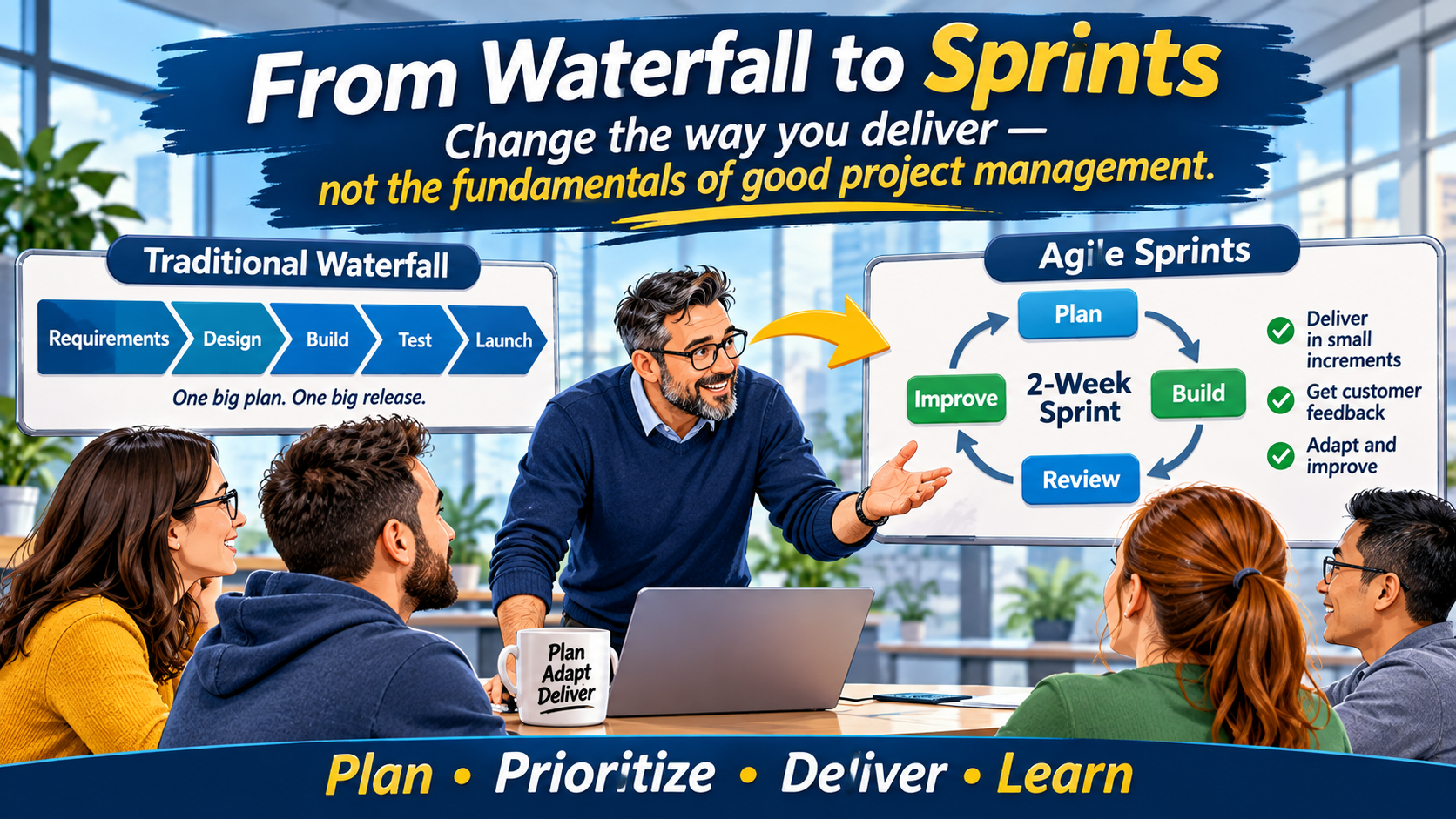
From Waterfall to Sprints: Making the Switch Without Turning Your Project Upside Down
Moving from traditional project management to Agile isn’t just about changing your schedule. It’s about changing how you plan, deliver, communicate, and work with your team.
Let’s face it. Most project managers are familiar with Waterfall.
You start with requirements, develop a project plan, define the scope, build your schedule, identify dependencies, and establish milestones. Everyone knows what needs to be delivered, when it needs to happen, and who is responsible.
You follow the plan, monitor progress, manage changes, and hopefully deliver everything on time and within budget.
It’s a familiar approach, and for many projects, it works very well.
But what happens when the project changes faster than you can update the project plan?
What happens when customers want to see progress earlier, developers need more flexibility, or stakeholders aren’t entirely sure what they want until they see something working?
This is where Agile and the concept of working in sprints can make a real difference.
I’ve always believed that project management isn’t about following one methodology religiously. It’s about understanding the project, the people, the risks, and the environment, then choosing the approach that gives you the best chance of success.
So, how do you move from Waterfall to sprints without throwing everything you’ve learned about project management out the window?
Let’s look at it.
1. Understand what is actually changing
The first mistake organizations make is assuming that switching from Waterfall to Agile simply means replacing a six-month project schedule with two-week sprints.
It doesn’t.
Waterfall generally organizes work around sequential phases. Requirements are defined, design is completed, development takes place, testing follows, and the solution is delivered.
Agile takes a different approach. Rather than waiting until the end to deliver the complete solution, teams work in smaller increments, regularly review what they’ve built, and use feedback to determine what happens next.
Think of it this way:
-
Waterfall: Plan the journey, define the destination, and follow the route.
-
Agile: Establish the destination, travel in smaller stages, check your progress, and adjust the route when necessary.
Neither approach is automatically better. A construction project with fixed engineering requirements may benefit from a more predictive approach. A software development project where requirements evolve may benefit from iterative delivery.
The important thing is understanding why you’re making the change.
You aren’t switching methodologies just because Agile is popular. You’re switching because you believe a different way of delivering value will produce better results.
2. Stop thinking in terms of phases and start thinking in increments
One of the biggest adjustments for a traditional PM is moving away from thinking that everything must be completed before the next phase begins.
In Waterfall, you might have:
-
Requirements gathering
-
Solution design
-
Development
-
Testing
-
Implementation
-
Closing
With sprints, you start looking at how the overall solution can be divided into smaller, meaningful pieces of work.
For example, imagine you’re implementing a new customer-facing software application.
Instead of planning to complete all development before showing anything to the customer, you might organize the work into increments:
| Sprint | Potential focus |
|---|---|
| Sprint 1 | Basic application structure and user access |
| Sprint 2 | Customer profile functionality |
| Sprint 3 | Transaction processing |
| Sprint 4 | Reporting and notifications |
| Sprint 5 | Additional functionality and refinement |
Each sprint should produce a usable increment that meets the team’s Definition of Done.
The customer and stakeholders can review progress regularly instead of waiting until the end of the project.
This creates opportunities to identify issues earlier, validate assumptions, and make adjustments before too much time and effort have been invested.
The big shift is moving from measuring progress by completed phases to measuring progress through working, valuable increments.
3. Break the project down into manageable pieces
This is where the Project Manager and Business Analyst can work particularly well together.
In Waterfall, requirements are often documented in considerable detail before development begins. In an Agile environment, we still need requirements, but we don’t necessarily need every detail finalized before the team starts working.
Instead, we start with a product backlog.
Think of the backlog as a prioritized list of everything the team believes needs to be delivered. It contains features, requirements, improvements, technical work, and sometimes defects.
The BA can help by:
-
Working with customers to understand their needs.
-
Identifying business requirements.
-
Breaking larger requirements into smaller user stories.
-
Defining acceptance criteria.
-
Identifying dependencies and constraints.
-
Helping prioritize requirements based on business value.
For example, instead of having one enormous requirement called “Customer Management,” break it into smaller pieces:
-
As a customer, I want to create an account so I can access the application.
-
As a customer, I want to update my contact information so my details remain current.
-
As an administrator, I want to view customer information so I can support customer requests.
These are much easier to discuss, estimate, prioritize, and potentially deliver within a sprint.
The important thing is that the work should be small enough to complete and demonstrate within the sprint, where practical.
You don’t want a team spending two weeks working on a user story only to discover that it was far too large to finish.
4. Establish your sprint schedule
Now we get to the actual mechanics of moving to sprints.
A sprint is a fixed-length period during which the team works toward a specific objective.
In Scrum, sprints are one month or less. Two weeks is a common starting point, although the appropriate length depends on the team and its work.
Let’s use a two-week sprint as an example.
An example two-week sprint
Day 1
Sprint Planning
Agree on the sprint goal and select work.
Days 2–9
Development
Daily Scrum, collaboration, testing and delivery.
Day 10
Sprint Review
Demonstrate the completed work and collect feedback.
Day 10
Retrospective
Discuss what worked and what can improve.
Illustrative schedule. Backlog refinement happens throughout the sprint, and the next sprint begins immediately after the previous one.
There are a few important activities to understand:
Sprint Planning
The team gets together to determine what it can realistically accomplish during the sprint and establishes a Sprint Goal.
Daily Scrum
A short daily meeting, usually 15 minutes, where Developers inspect progress toward the Sprint Goal and adjust their plan.
Sprint Review
The team demonstrates the results of its work and gathers feedback from stakeholders.
Sprint Retrospective
The team discusses how it worked together, what went well, what didn’t, and what improvements it wants to make.
These aren’t just additional meetings to fill up everyone’s calendar. Each has a specific purpose.
The Scrum Guide provides the formal definitions and expectations for these events.
Scrum Guides+1
5. Change the way you manage and measure progress
This is probably one of the biggest adjustments for a traditional project manager.
In Waterfall, we might measure progress by looking at completed phases, milestones, activities, and percentage complete.
In a sprint-based environment, we need to look at what the team is actually delivering.
For example, instead of reporting:
“Development is 75% complete.”
You might report:
“During Sprint 3, the team completed customer profile functionality, including account updates and validation. The functionality was demonstrated during the Sprint Review. Reporting functionality remains in the backlog for a future sprint.”
That’s a much more meaningful conversation.
Some useful measurements include:
-
Sprint Goal achievement: Did the team accomplish the objective?
-
Velocity: How much estimated work the team completes per sprint, when using story points.
-
Cycle time: How long work takes from starting to completion.
-
Defect trends: Are quality issues increasing or decreasing?
-
Release progress: How much of the required product functionality has been completed?
-
Customer feedback: Are we delivering something customers actually find useful?
One important caution: velocity is a planning aid, not a productivity score. Comparing the velocity of different teams can be misleading.
The objective isn’t to get everyone working faster. It’s to deliver value more consistently and improve the way the team works.
6. Understand that the PM role changes, but doesn’t disappear
I sometimes hear people suggest that Agile eliminates the need for project managers.
I don’t agree.
The responsibilities may change depending on the delivery framework and organizational structure, but there is still plenty of project management involved.
Someone needs to coordinate stakeholders, manage dependencies, monitor risks, understand financial constraints, communicate status, manage expectations, and ensure the work remains aligned with business objectives.
In Scrum, the Product Owner, Scrum Master, and Developers have defined accountabilities. The traditional Project Manager role isn’t a separate Scrum accountability.
However, a PM can still contribute significantly in a broader project or organizational context.
For example:
| Traditional PM activity | How it can evolve |
|---|---|
| Develop project schedule | Coordinate release and sprint planning |
| Manage scope | Support backlog and change discussions |
| Track project progress | Monitor delivery, risks and dependencies |
| Manage customer expectations | Facilitate regular customer feedback |
| Report status | Communicate increments and outcomes |
| Manage project risks | Review and address risks continuously |
| Coordinate resources | Help manage cross-team dependencies |
The key is not to take over the team’s sprint work.
A good PM creates an environment where the team can succeed, removes organizational obstacles, and keeps stakeholders informed.
7. Don’t forget the importance of the customer
One of the biggest advantages of working in sprints is that customers get more opportunities to see what is happening.
In Waterfall, customers might wait months before seeing a working solution.
With sprints, they can see incremental progress, provide feedback, and help influence priorities.
But this only works if customers are involved.
Don’t invite customers to a Sprint Review and expect them to magically understand what they’re looking at.
Explain what was planned, what was completed, what remains outstanding, and what decisions or feedback you need from them.
Also, be clear about the difference between a sprint review and a formal production release. A completed increment doesn’t automatically mean it is ready to be deployed to customers.
Customer communication remains one of the PM’s most important responsibilities.
8. Consider a hybrid approach before changing everything
Here’s something worth considering.
You don’t necessarily have to move an entire project from Waterfall to Agile.
Sometimes a hybrid approach makes more sense.
For example, imagine you’re implementing a banking software solution.
You may still need:
-
A formal project charter.
-
A defined budget.
-
A high-level project schedule.
-
Contractual milestones.
-
Data migration planning.
-
Security and compliance approvals.
-
Formal testing and implementation sign-offs.
Those things don’t disappear because you’re working in sprints.
However, your software configuration, development, reporting, and customer feedback activities might be managed through iterative sprint cycles.
This is where hybrid project management can be particularly useful.
You retain the governance and controls required by the organization while introducing more flexibility into the actual delivery of the solution.
In my opinion, this is often a more practical transition than trying to convert every activity into a sprint.
PMI’s guidance on Agile and life cycle selection recognizes predictive, adaptive, and hybrid approaches. The right choice depends on the nature of the work and its environment.
Project Management Institute+2
9. Make the transition gradually
If your organization is moving from Waterfall to Agile, I wouldn’t recommend changing everything overnight.
Start with a pilot project or a team that is willing to experiment.
Here is a practical transition plan:
| Step | What to do |
|---|---|
| 1. Assess | Identify which projects would benefit from sprints. |
| 2. Prepare | Educate the team on Agile principles and responsibilities. |
| 3. Organize | Create a prioritized product backlog. |
| 4. Break it down | Convert requirements into manageable user stories. |
| 5. Plan | Establish sprint lengths, goals, and meeting schedules. |
| 6. Deliver |
Run the first few sprints and demonstrate progress. |
| 7. Review | Gather feedback from customers and the delivery team. |
| 8. Improve | Adjust the approach based on lessons learned. |
Don’t expect the first sprint to be perfect.
The team might underestimate work, struggle with user stories, or discover that certain dependencies make it difficult to deliver within two weeks.
That’s okay.
The whole point is to learn, adapt, and improve.
10. Where can AI help with the transition?
As someone interested in the intersection of Project Management, Business Analysis, and AI, I think there are some great opportunities here.
AI can help teams make the transition without adding unnecessary administrative work.
For example:
-
Requirements: Help transform lengthy business requirements into smaller user stories.
-
Acceptance criteria: Generate initial acceptance criteria for the BA and team to review.
-
Backlog management: Identify duplicate requirements, missing information, and potential dependencies.
-
Sprint planning: Help summarize the backlog and identify items that may need further refinement.
-
Documentation: Summarize sprint reviews and retrospectives.
-
Reporting: Prepare sprint summaries and highlight potential delivery risks.
-
Customer communications: Help prepare updates explaining completed work and upcoming priorities.
Imagine taking a 30-page business requirements document and asking an approved AI assistant to identify potential user stories, group them by business capability, and suggest acceptance criteria.
The BA still validates the requirements. The Product Owner still prioritizes the backlog. The Developers still determine how the work gets done.
AI simply helps reduce some of the administrative effort.
As always, human oversight is important. AI-generated requirements and estimates need to be reviewed before they become part of the team’s delivery commitments.
One Last Thins… It’s about changing how we deliver value
Moving from Waterfall to sprints isn’t about abandoning everything we know about project management.
We still need planning. We still need requirements. We still need schedules, budgets, risk management, stakeholder engagement, and communication.
What changes is how we organize and deliver the work.
Instead of spending months planning everything and waiting until the end to see the results, we break the work into smaller pieces, deliver more frequently, gather feedback, and adjust as we go.
For traditional PMs, this can be a significant adjustment. It requires a different mindset, more collaboration, and a willingness to accept that the plan will evolve.
But it can also be a very rewarding way to work.
My advice?
Don’t throw away your Waterfall toolbox. Learn when to use it, when to use sprints, and when a combination of both makes the most sense.
Good project management isn’t about being Waterfall or Agile.
It’s about delivering the right outcome, using the right approach, with the right people.
And if we can use a little AI along the way to save time and make our teams more effective, even better!
References and further reading
These are established sources worth exploring if you’re considering a move to Agile or want to understand the principles behind sprint-based delivery.
1. Project Management Institute (PMI) – Agile Practice Guide, Second Edition (2026). Covers Agile foundations, life cycle selection, hybrid approaches, tailoring, and modern delivery practices. PMI Agile Practice Guide.
2. The Scrum Guide (2020) – Ken Schwaber and Jeff Sutherland. The official definition of Scrum, including accountabilities, events, artifacts, and sprint practices. Read the official Scrum Guide.
3. The Agile Manifesto (2001). The original four values and twelve principles behind Agile software development. Read the Agile Manifesto.
4. Association for Project Management (APM) – Principles of Agile Working. An explanation of Agile principles and how they differ from traditional project management. APM: Principles of Agile Working.
5. Scrum.org – What is a Sprint? A useful explanation of sprint duration, purpose, and how sprint events fit together. Understanding the Scrum Sprint.
Note: Scrum is a specific framework for working in an Agile way. Not every team that uses sprints is necessarily using Scrum, and not every Agile approach requires sprints.